Bra Sizing by the Numbers
Facts a journalist can check, stated with their limits. Everything below is either arithmetic from the published methodology or a claim with its provenance attached.
The fact behind most confusion
Same measurements (33″ underbust, 37″ bust) five labels. Nothing about the body changes between columns; only the notation does. Cup letters agree to D and diverge above it (US DDD = UK E = EU F).
Facts that follow from the system
Cup letters are not volumes. A 30D and a 34B hold about the same volume; "D cup" alone tells you nothing about size. This single fact explains most bra-sizing confusion and is the most useful correction a story can make.
The '80% wear the wrong size' figure, with provenance
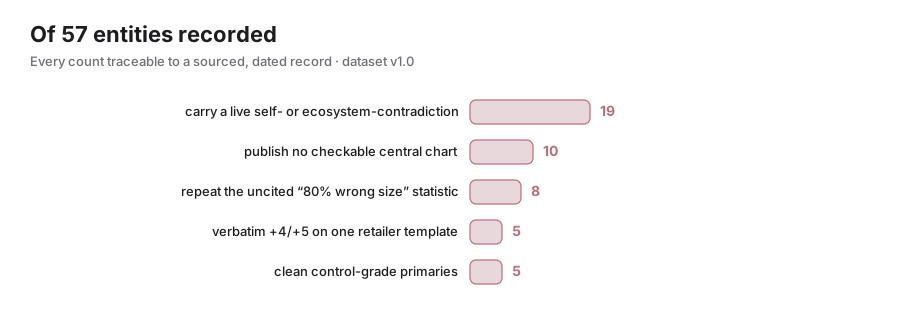
The widely repeated statistic that 70–85% of women wear the wrong bra size traces to a small number of studies: including a 2008 study in Chiropractic & Osteopathy (Wood, Cameron & Fitzgerald, n=104) reporting 80% in ill-fitting bras, and earlier retail fitting surveys: none of which sampled the general population. The direction is well supported by fitters' experience: the dominant error is a band too loose and a cup too small, which is exactly what the traditional +4 measuring rule produces.
Brasize.ai's position: cite the figure as "commonly reported" with its source, not as a population fact; and report the direction of the error, which is the actionable part.
| Claim | Status | How to state it |
|---|---|---|
| Most women wear the wrong size | Supported in direction; percentages from small studies | "Studies of fitted samples repeatedly find a majority in ill-fitting bras, usually a loose band and small cup." |
| The average size is 34DD | Retail sales figures, US/UK, vary by source and year | "Retail data put 34DD/36DD among the most-purchased sizes; there is no measured population average." |
| Adding 4 inches to the underbust gives the band | Outdated method | "A legacy rule from non-stretch fabrics; modern fitting uses the snug underbust directly." |
| A US DDD is a UK E | Arithmetic | State as fact: six inches of difference in both systems." |
One-line answers for stories
| Question | Answer |
|---|---|
| What do the number and letter mean? | Number = ribcage measurement in inches (band); letter = bust minus band, one inch per letter (cup). |
| What is a sister size? | Same cup volume on a different band: 34C, 32D and 36B. |
| Why do sizes differ by country? | Different band units (inches, centimeters, dress numbers) and different cup alphabets above D. |
| Why do bras fit differently across brands? | Same label, different grading: bands firm or soft, cups small or generous, wires narrow or wide. |
| How should a bra fit? | Band level and snug on the loosest hook; cups full with no gap or spill; gore flat; straps light; wire on the ribcage. |
The Brand Sizing Variance Dataset. 57 entities, every claim sourced
In August 2026 we collected the published size charts, calculators and measuring instructions of 52 bra brands and 5 retailer chart-publishers (every entity covered on this site) recording each with its primary source URL and an access date of 2026-08-22, and analyzing them against our published methodology and its declared constants. Clean brands are recorded as clean. Nothing below is estimated: where a chart was widget-gated, missing, or broken, that is what the record says.
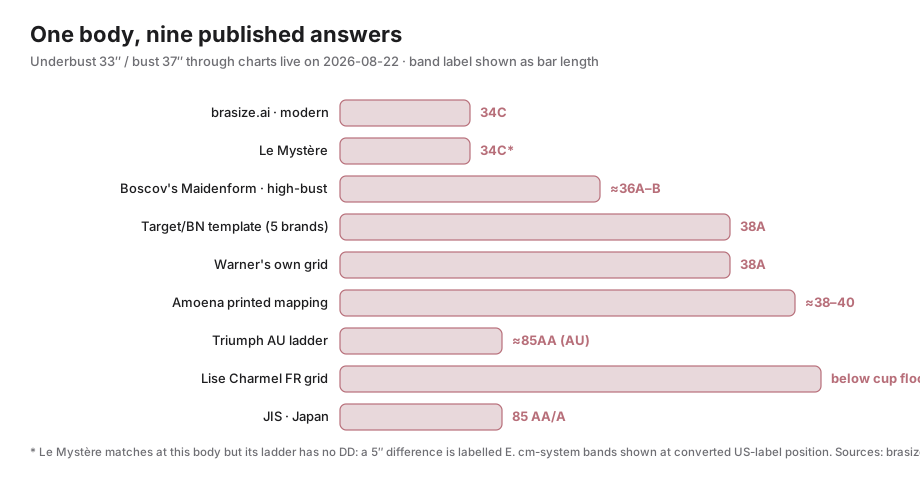
What the dataset shows: in the brands’ own words
The retired formula survives through syndication, not through brands. The “add 4 or 5 inches” band rule, retired by nearly every major methodology, persists mainly as a retailer-authored template stamped across other brands’ names: while the brand that invented cup sizes in 1935 still publishes its +4 grid first-party. Meanwhile one national brand’s sister-size guide instructs shoppers to subtract “the band size (the number you calculated, not the raw underbust measurement)”: an addition step that is load-bearing and never published.
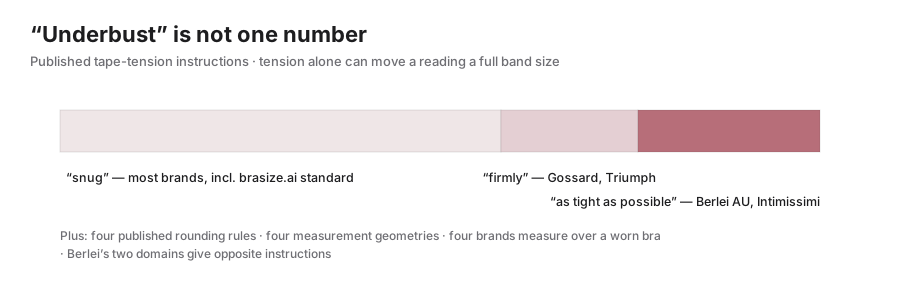
“Underbust” is not one number. Published instructions range from “snug” through “firmly” to “as tight as possible”, and one brand’s two national websites give opposite tension instructions. Four different published rounding rules assign different bands to the same tape reading. Four brands instruct measuring over a worn bra. Two majors measure a single-breast arc instead of a circumference: including the world’s largest sportswear company.
The labels don’t interoperate, and the market already knows. Above a D cup, three notation systems coexist (letter-strings to DDDDDD, continued letters, and D-multipliers like 4D), two major US brands publish ladders with no DD at all, and one large US retailer found cross-brand cups so incompatible that it invented its own translation system covering 150+ brands. A sports-bra maker publishes an 11-brand comparison of measuring methods as customer guidance.
One vendor states the thesis outright. A major athletic brand’s European size guide says its technique “is to find your sports bra size, not the size of an underwire bra”: a formal declaration that two of its own sizes are different quantities for the same body.
The clean cases matter as much as the broken ones. Several brands publish internally consistent, openly checkable charts: the standard is achievable. Fit-lore converges exactly where a brand’s deviation is real and stable. And Japan, the one market with a codified standard, is the one market where the ecosystem agrees. Variance is a policy outcome, not a law of nature.
Handling notes we hold ourselves to: findings about post-surgical fitting are treated as errata to be reported to the brand first, not gotchas. HauteFlair, owned by this site’s owner, is recorded under the identical rubric as every other retailer, with the relationship disclosed in the dataset itself. See About.
Download the dataset
Everything above resolves to a record you can open. Reuse is licensed CC BY 4.0 with attribution to “brasize.ai brand variance dataset.”
| File | Contents | Format |
|---|---|---|
| brand-variance-dataset.csv | One row per entity: sizing system, chart class, legacy-addition status, primary source URL, access date, headline note | CSV |
| brand-variance-dataset.json | Full records: band rows, cup methods, findings with provenance, the 80%-claim carrier tally, citable industry witnesses | JSON |
| README.txt | Field guide, honesty notes, handling requirements, licence, contact | TXT |
Charts on this page are downloadable SVG (right-click → save); print-quality versions on request.
Story angles, quotes and availability
Angles the data supports: the consumer angle (why your size differs in every store, and the five-step check that fixes it); the business angle (one holding company, six sizing philosophies; a retailer authoring another brand’s chart); the policy angle (Japan standardized and it worked); the history angle (the 1935 inventor of cup sizes still publishes the formula everyone else retired); the internet-archaeology angle (retired charts living on as stockist PDFs years after brands abandoned them).
Quotable, pre-cleared (attribute to brasize.ai research): “A cup letter is a relationship, not an amount: a D on one band holds less than a C on another.” · “The same tape measurements produce band labels from 34 to 40 depending on whose chart you open.” · “Variance is a policy outcome, not a law of nature. Japan proved it.” · “The +4 rule didn’t survive in brand methodology; it survived in syndication.”
Interviews & verification: the research team is available for background, methodology walk-throughs and data verification via press@brasize.ai. Every claim in the dataset carries the URL to check it against.
Boilerplate: Brasize.ai is an independent bra-sizing reference publishing calculators, conversion systems and fitting guidance built on a versioned, openly declared methodology, in five languages. Its 2026 Brand Sizing Variance Dataset documents the published sizing charts and measuring methods of 57 industry entities with full source provenance. Ownership and editorial rules: brasize.ai/about.
Citing and contacting
Press: answered
What percentage of women wear the wrong bra size?
Commonly reported as 70–85%, from small fitted-sample studies (e.g. Wood, Cameron & Fitzgerald, 2008, n=104) and retail surveys, not population data. The direction (a band too loose and a cup too small) is well supported.
What is the most common bra size?
Retail sales data in the US and UK put 34DD and 36DD among the most purchased; there is no measured population average, and purchases reflect availability as much as bodies.
How many bra sizes are there?
In standard US notation, 10 bands (28–46) × 12 cups (AA–K) = 120; specialist ranges extend both. Each size has up to two sister sizes and a label in eight systems.
Who is Brasize.ai?
An independent bra-sizing reference: calculator, size guides, brand sizing, shapes and comparisons: published by NativeCode. It does not sell bras.
Opens HauteFlair’s own hub page; use your measured size there. HauteFlair is owned by the same company as Brasize.ai; that relationship never changes the sizing math, charts, or fit advice on this page. How this site makes money.